USA Restoration Sparta Township
📞 862-421-8933
Sparta Township • NJ

Mold Remediation in Sparta Township.

Containment, removal, and prevention of mold growth after water events or chronic moisture problems.

Local team in Sparta Township Honest, transparent pricing 24/7 emergency line
Same Crew Mitigation team finishes the rebuild
Real Dispatch Human answers in NJ
IICRC-Standard S500 / S520 / S700 protocols
Service Overview

How We Approach It

Mold remediation is what happens when a water event was not properly dried, or when a chronic moisture problem was ignored long enough for fungal growth to establish. We follow the IICRC S520 standard for safe, effective mold removal in {{city}} properties.

What's Included

  • IICRC S520 protocol
  • Negative-air containment
  • HEPA filtration
  • Source removal to documented line
  • Antimicrobial application
  • Optional 3rd-party clearance testing

Why Bleach Does Not Kill Mold (And What Actually Does)

The single most common mold-remediation myth: bleach kills mold. It does not. Bleach is mostly water plus sodium hypochlorite. It can lighten surface staining (which is why people think it worked) but the chlorine evaporates while the water soaks into porous material, feeding the fungal growth underneath. Within weeks the visible mold returns.

What actually works: physical removal of the contaminated substrate. If mold is on porous material (drywall, insulation, untreated wood, carpet pad), remove the material. If mold is on hard non-porous surfaces (sealed concrete, finished wood, ceramic tile), HEPA vacuum + wipe with EPA-registered antimicrobial. Either way, the source moisture has to be eliminated first or the mold returns regardless of what cleaning was done.

Antimicrobial chemicals have a place in our protocol — applied AFTER source removal, on remaining hard surfaces, as a final step before reconstruction. They do not substitute for source removal. A {{city}} restorer who promises to "spray and seal" without removing contaminated substrate is selling a treatment that fails predictably.

Containment + Hepa Filtration — Why the Plastic Sheeting Matters

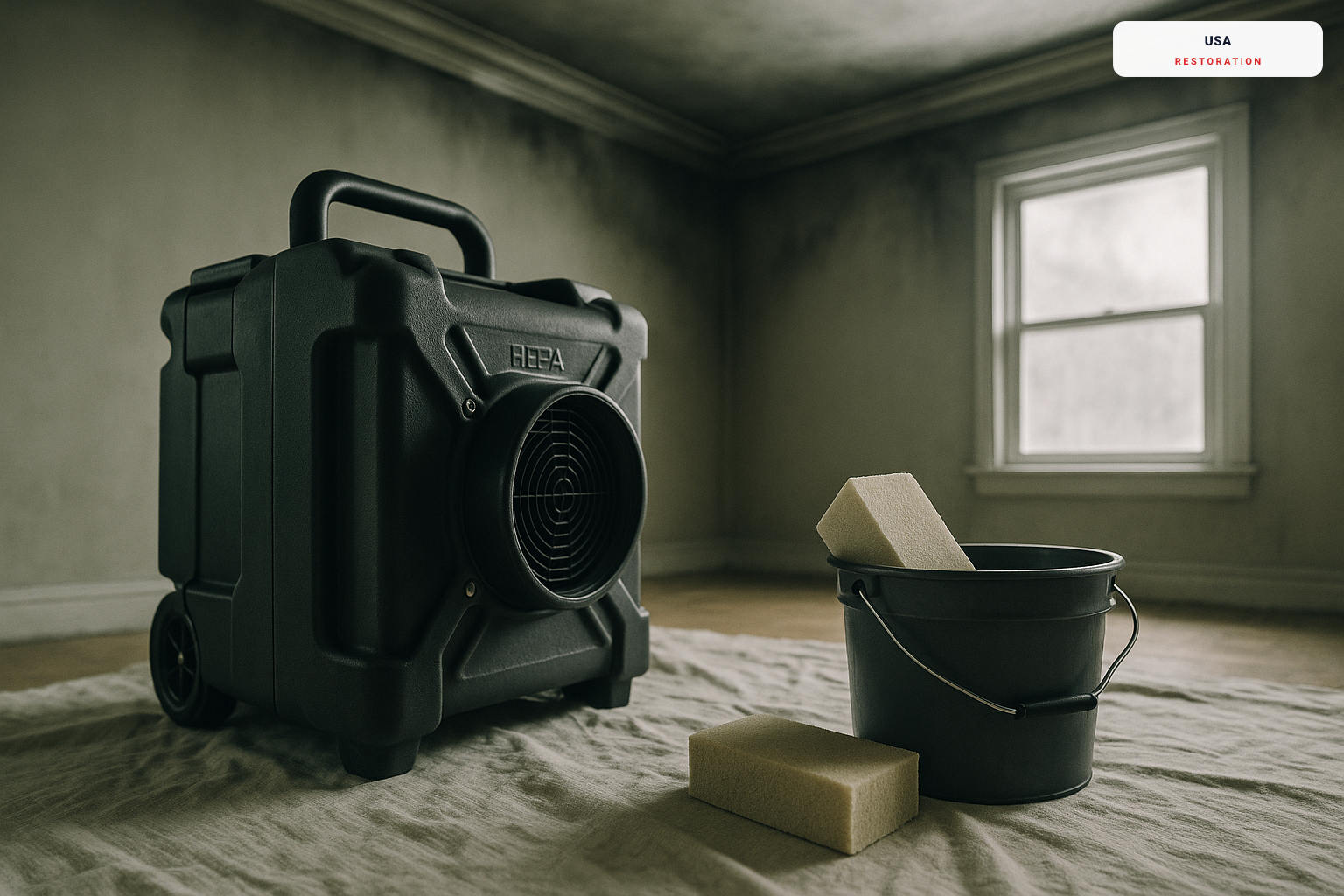
If you walk into a mold remediation job and the contractor is not running HEPA-filtered negative-air containment, walk back out and call someone else. Disturbing mold growth releases millions of spores into the air. Without containment, those spores spread throughout the rest of the property — turning a contained 200 sqft mold problem into a whole-house contamination event.

Proper containment: 6-mil plastic sheeting + zip-wall framing creates a sealed barrier between the affected area and the rest of the structure. HEPA-filtered air scrubbers run inside the containment to capture airborne spores during the work. Negative-air pressure differential (containment is at lower pressure than the rest of the structure) means any air leakage flows INTO the containment rather than out. PPE for the techs: Tyvek suits, respirators with P100 cartridges, gloves, foot covers.

This setup adds equipment cost and labor time to a remediation job, which is why fly-by-night operators skip it. The cost difference shows up later — when the contamination has spread to areas it was not in before, and the second remediation is 3-5x the first.

Process

Our Process

  1. 01

    You Call

    A real person answers 24/7. We get the address, the situation, what equipment to load. Two minutes max on the call.

  2. 02

    We Roll

    Truck heads out within minutes for active losses. Standard target is on-site within 60 minutes anywhere in our Sparta Township footprint.

  3. 03

    Stop the Damage

    Water out, contaminated material removed, drying gear deployed, affected areas sealed off. The first 24 hours decide whether the loss stays small.

  4. 04

    Dry It Right

    Air movers + dehumidifiers run for 3-5 days. We log moisture readings daily, reposition equipment until every wet substrate hits the dry standard.

  5. 05

    Put It Back

    Same crew that pulled out the wet drywall puts the new drywall back. One contract from first call to final walk-through.

The difference

Why Customers Choose Us

Real reasons. No invented stats, no manufactured awards.

  • 01

    Honest Timelines

    Standard residential drying: 3-5 days. Hardwood-heavy losses: 7-10 days. Reconstruction: 2-12 weeks depending on scope and material lead times. We give realistic schedules at the start, not optimistic guesses that slip.

  • 02

    No Hidden Scope

    Xactimate scope, line-item pricing, supplements documented and approved before work proceeds. The price you see at scoping is the price you pay — barring discovered conditions that get added as transparent supplements with carrier approval.

  • 03

    Trade Coordination Handled For You

    Specialty work — plumbing, electrical, HVAC, structural — coordinated through us. We bring qualified trades into the scope rather than handing the homeowner a list of phone numbers.

Service Area

Serving Sussex County

From our Sparta Township base we cover Sussex County and the immediately surrounding NJ municipalities. Sub-hour response on active losses, pre-staged equipment for storm season, IICRC-standard methodology applied to every job regardless of size.

Counties Covered

  • Sussex County, NJ

Cities We Service

Each Sussex city below opens a local page with arrival times from our Sparta Township base and the loss patterns we handle most often in that municipality.

Not sure if you're in our area? Call 862-421-8933 and we'll tell you in 30 seconds.
FAQ

Frequently Asked Questions

If you don't see your question, just call or message us.

What happens to my contents during restoration? +

For minor losses, we move content within the home to dry/safe areas and clean as needed. For significant losses, we offer pack-out service — your contents are catalogued, transported to our cleaning facility, sorted by material type, cleaned appropriately, and stored climate-controlled until the property is ready for re-occupancy. Pack-out keeps possessions out of the affected environment so they stop absorbing additional damage.

How do you handle pets and kids during the work? +

For most water restoration work, pets and kids stay in unaffected areas of the home and life continues. We coordinate access timing so equipment doesn't prevent normal household routines. For Cat-3 sewage cleanup, the affected area is evacuated during the cleanup phase (typically 5-7 days) — we discuss temporary arrangements at our first on-site visit.

Are your prices in line with what insurance pays? +

Yes — our scopes are written in Xactimate at carrier-standard pricing for the NJ market. We do not inflate scope to chase coverage and we do not cut corners to under-bid. The price reflects the work IICRC standards require for the loss type. Adjusters see our scopes regularly and approve them without back-and-forth because the line items match the documented conditions.

Do you handle commercial restoration? +

Yes, we handle small to mid-size commercial restoration in Sussex County — offices, retail, medical, light industrial. Commercial work has different operational tempo than residential (tenant operations come first, after-hours noise scheduling, larger COI requirements). We have separate residential and commercial tech rotations because the workflows differ.

What if I find more damage after the work is done? +

If hidden damage emerges after reconstruction completes — usually because moisture migrated through a path that was not visible during initial scoping — we re-engage at no additional charge for the warranty period (typically 1 year on workmanship). Beyond warranty, we re-evaluate as a new claim. The initial documentation we keep on file makes the second claim faster and clearer for the adjuster.

Can you work in occupied condo and apartment buildings? +

Yes — we have COIs ($2M general liability + workers comp, additional insured naming the building) on file for most major condo and apartment complexes in our service area. We work within building noise windows, use service elevators, and coordinate with building management on access protocols. For larger buildings we are pre-cleared for vendor approval so paperwork does not delay active-loss response.

How do you decide what materials to remove vs save? +

IICRC S500 has clear material removal criteria based on water category and how long the material was wet. Cat-1 water + reached within 24-48 hours = often save in place. Cat-3 water = porous materials always come out. Borderline cases get the moisture-meter test: substrate that returns to dry standard with equipment runtime gets saved; substrate that stalls above dry standard for 5+ days gets removed.

Call Now • Sparta Township

Damage in Sparta Township, Nj? Iicrc-standard Restoration Dispatched Now.

One phone call gets a truck rolling. Real Sparta Township team, real local response time, no automated phone tree. We'll be on site fast.

📞 Tap To Call 862-421-8933

24/7 Emergency Dispatch

📞 Call 862-421-8933